Authenticity is a hallmark of the new Jewish spirituality. During the 1960s and 1970s, experimentation with Jewish religious practices was most often marked by efforts to incorporate other traditions into Judaism or to innovate new rituals and liturgy. By the late 1990s, however, Jews dissatisfied with American denominational Judaism became ba’al teshuvah—either returning to Orthodoxy or, in more progressive circles, seeking a return to a pre-rabbinic, Torah-centric Judaism that modeled the patriarchs’ direct relationship with God.
In a region filled with “Jew-Bus,” and “Hind-Jews,” Chochmat haLev in Berkeley offers an example of a congregation that appeals to Jews who are dissatisfied with institutional and denominational Judaism. These Jews—mainly but not exclusively young people in their twenties and thirties—are looking for a deep and unmediated Jewish experience.
Chochmat began by offering meditative practices based firmly in the Jewish tradition. Rather than claim to be innovating, Chochmat’s teachers traced Jewish meditation to Abraham’s devekut (devotion to oneness with God), the mystical chanting of the ineffable Name during the Temple period, the spiritual immersion practiced by kabbalists from the middle ages onward, and the techniques of hitbodedut begun by Rabbi Nachman of Bratslav.
In focusing on Jewish meditation in 1995, Chochmat haLev co-founders Nan Fink Gefen and Avram Davis were at the forefront of a wave of interest. The year 2000 would see the establishment of the New York-based Institute of Jewish Spirituality, a Jewish meditation center run by Rabbi Sheila Pelz Weinberg; Makor Or, a San Francisco-based center founded by Rabbi Alan Lew (z’’l) and Norman Fischer; as well as a new emphasis on meditation at Elat Chayyim under Rabbi Jeff Roth and a burst of books on the topic (among them books by Gefen and Davis).
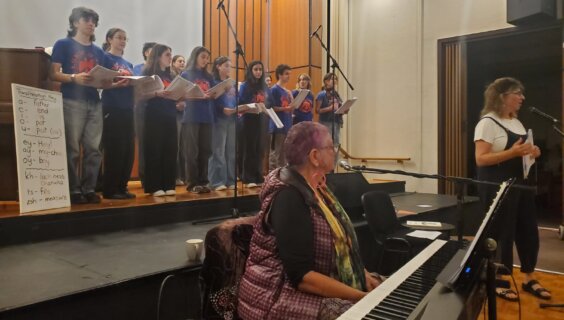
Jewish meditation led to Jewish prayer. While meditation turned practitioners inward, prayer turned them outward. Those attending Chochmat’s classes and soon, prayer services, saw meditation and prayer as two sides of the same coin, an attempt to access what board member Lainey Feingold describes as “a richness of spiritual tradition. That has gotten lost [in Judaism] along the way. Growing up, I sat through a million services but the deeper spiritual meaning—I didn’t know any of it. The spiritual team at Chochmat creates broader access to that.”
For its first ten years, the core of those attending Chochmat services were being trained as spiritual leaders through Chochmat’s medtiation programs. Chochmat also had the advantage of being led by Avram Davis, a charismatic leader who drew on techniques from African American churches to draw congregants into deeper prayer.
In 2005, however, Davis left, and, simultaneously, the emphasis of the organization shifted to prayer and communal life and away from meditation and leadership training, although Chochmat still holds weekday meditation sessions and meditation classes. The question the congregation faces now is whether they will be able to maintain the spiritual richness of their prayer if that prayer is not led by a charismatic leader or grounded in hitbodedut and other Jewish practice.
Chochmat seems to have overcome the first hurdle. The community continued after Davis left and is now, perhaps, more stable, being led by both a new rabbi, SaraLeya Schley and its long-time musical director, Brian Schachter-Brooks. But Rabbi Schley does wonder what will happen if tefillah is not grounded by some other set of practices like hitbodedut. The question the community must face is this:
Was it the tension between inward and outward, meditation and prayer, that enabled the Chochmat community to develop? or is the spiritual longing expressed by its current members enough to maintain the community?
This is a question faced by all the communities attempting to deepen spiritual experience. If a charistmatic leader leaves, or if a set of grounding practices (whether they be halakhah or hitbodedut) fall off, can a deep spiritual experience be sustained? Most of the new spiritual communities in the Jewish world are still led by their original charismatic founders or have kept to their original mission mix. Chochmat is worth watching, because how it evolves will provide key insights into the future of Jewish prayer and the new Jewish spirituality.
For a discussion of Chochmat’s evolution from school to synagogue, see my essay in the Forward
![[the current issue of ZEEK]](http://zeek.forward.com/image/2/100/0/5//uploads/zeeksummer10c1-4c3a3840.jpg)
More articles by
More articles in
ZEEK is presented by The Jewish Daily Forward